Skip to content
Gregor WeberPhD

Expertise

Immunology

What the immune system actually remembers after an infection or a vaccine, and why the second encounter with a pathogen looks so different from the first.
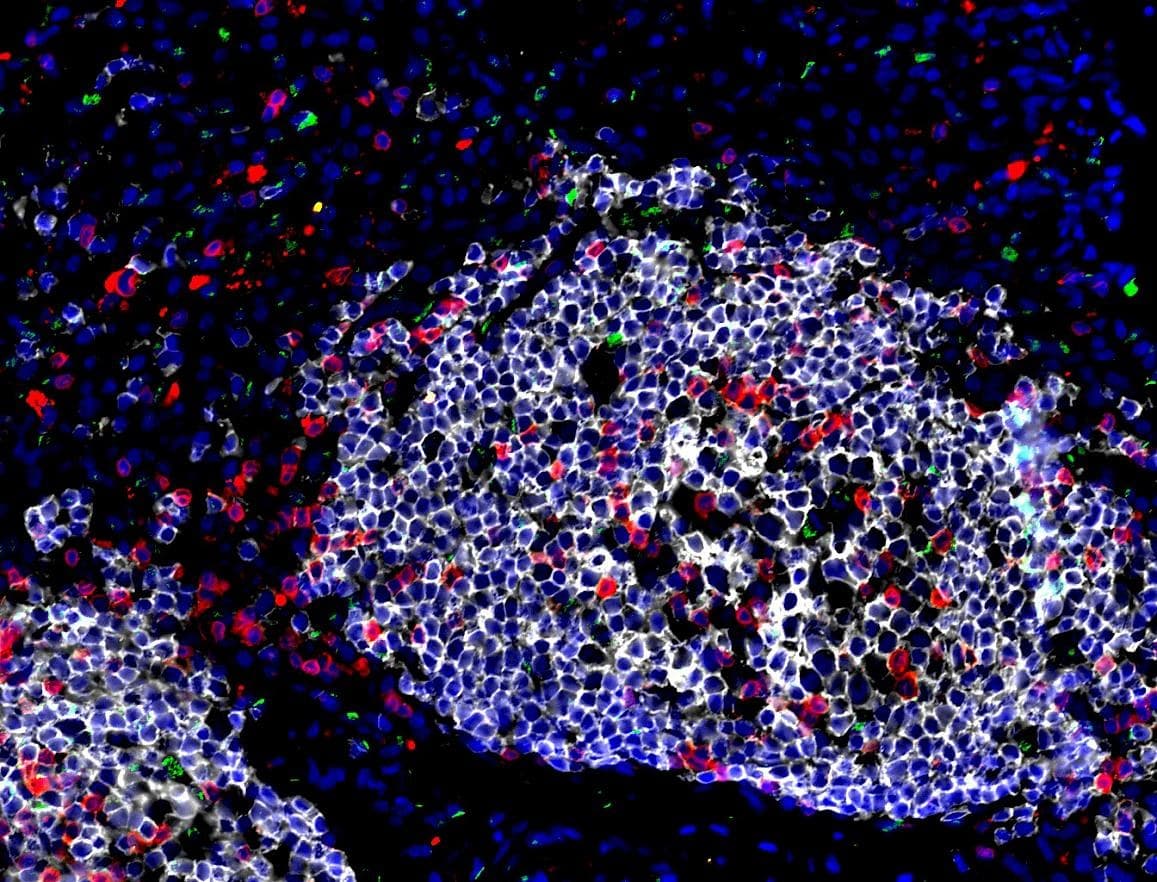
A fluorescence micrograph of lung tissue. Cell nuclei are stained blue, forming a dense rounded cluster; individual cells scattered through and around it are picked out in green and red.
Innate lymphoid cells (green) near and within a granuloma — a small area of inflammation — in a non-human primate infected with Mycobacterium tuberculosis, the bacterium that causes TB. — National Institute of Allergy and Infectious Diseases, NIH · Public domain (Public Domain Mark 1.0)
A first and second immune response comparedAfter a first exposure the immune response rises slowly and modestly. After a second exposure to the same target it rises much sooner and reaches a substantially higher level.1st exposure2nd exposurefaster, larger, longer
Described in words

After a first exposure the immune response rises slowly and modestly. After a second exposure to the same target it rises much sooner and reaches a substantially higher level.

The immune system is often described as an army. It is closer to a filing system that learns: it keeps a record of things it has met before, and that record is what makes a second encounter faster and less costly than the first.

Almost everything useful about vaccination follows from that one fact — and so do most of the honest caveats, because a record can fade, and a pathogen can change enough that the record no longer matches.

This site can use Google Analytics to count visits. Until you accept, it is loaded but switched off: no cookie is set and nothing identifies you. Declining changes nothing about how the site works.